
Blog
Pistachio Defects: Quality Standards, Types, and Export Impact
Short answer
Defective pistachio nuts are pistachios that have one or more quality problems—such as closed shells, broken shells, discoloration, non-uniform size, foreign materials, or other defects—that reduce their commercial grade, consumer appeal, and sometimes their export value.
In bulk trade, the impact of a defect depends on its type, severity, and percentage in the lot. Some defects mainly affect appearance and price, while others can affect safety and lead to rejection. That is why buyers should always define acceptable defect limits, size grades, and sorting standards before placing an order.
If you want to choose the right variety before inspecting defects, start with our guide to different types of Iran’s pistachios or compare Iranian pistachio vs California pistachio.
What are defective pistachio nuts?
Defective pistachio nuts are pistachios that do not meet the desired commercial or quality standards for shape, shell condition, size uniformity, cleanliness, or safety. In the pistachio trade, defects matter because they directly affect:
- grade
- price
- shelf appeal
- processing efficiency
- export suitability
A lot with fewer defects usually earns a higher price, while a lot with more defects is typically downgraded or discounted.
For bulk buyers, the most important question is not just whether a pistachio is defective, but what kind of defect it has and how much of it is present.
Why pistachio defects matter in bulk trade
In commercial pistachio buying, the product is rarely judged by a single nut. Buyers evaluate a sample from the lot and measure how consistent the entire shipment is.
That means defects affect business in three ways:
- Quality perception — the product looks better or worse to the customer
- Commercial grade — the lot may be classified as premium, standard, or lower grade
- Final price — the more defects, the lower the market value
This is especially important for exporters and processors who need consistent supply, predictable sizing, and clean sorting.
At Pinut, this is also why product selection and quality control are so important across our products and services.
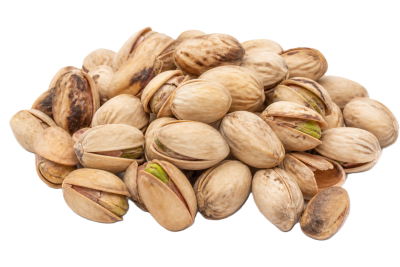
Main types of defective pistachio nuts
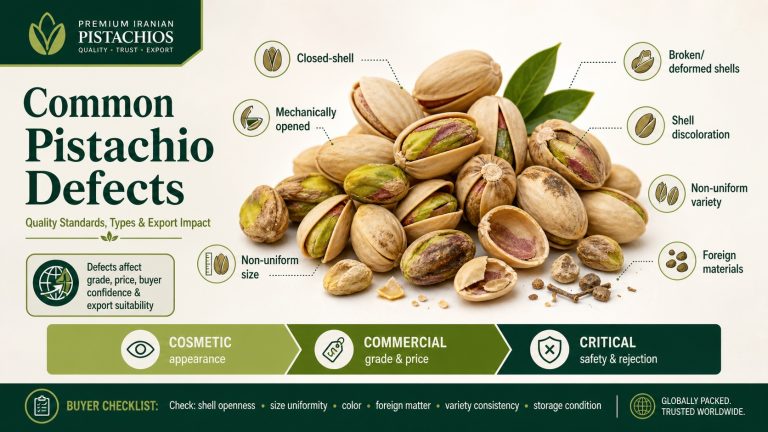
1) Closed-shell pistachios
Closed-shell pistachios are nuts whose shells have not naturally opened during ripening. Since the kernel is not easily accessible, these nuts are less desirable in snack markets.
They are not always “bad” in a food-safety sense, but they are usually considered a commercial defect in in-shell trade.
Why they matter:
- reduce edible convenience
- lower visual appeal
- may require additional sorting
- can reduce commercial grade
In some markets, closed-shell pistachios are tolerated in limited amounts, but buyers should always define the acceptable percentage in advance.
2) Mechanically opened pistachios
Mechanically opened pistachios are closed-shell nuts that have been split by machine to mimic naturally open pistachios. They can be useful in trade, but they are not the same as naturally open nuts.
Commercial impact:
- may be acceptable in bulk
- usually priced below premium naturally open pistachios
- can show slight shell deformation
- need careful sorting to avoid inconsistency
For buyers comparing commercial forms and grading, our guide to Iranian pistachio types is a useful starting point.
3) Broken or deformed shells
Broken, cracked, or visibly deformed shells are common defects in handling, transport, or mechanical processing. These defects affect the outer appearance and may signal poor handling.
Why they matter:
- reduce visual quality
- create a lower-grade appearance
- may increase the chance of kernel damage
These nuts are often downgraded in premium retail markets.
4) Dark stains and shell discoloration
Dark stains, spots, or discoloration on the shell can come from environmental conditions, storage issues, or post-harvest handling.
Commercial impact:
- affects appearance
- lowers buyer confidence
- can reduce retail suitability
For export-focused buyers, shell appearance is often almost as important as kernel quality.
5) Non-uniform size
Pistachios in the same lot are not always the same size. However, strong size uniformity is a key marker of quality in commercial grading.
A lot with mixed sizes may still be usable, but it is less attractive for premium packaging and branded retail products.
This is one reason buyers often compare varieties such as Fandoghi vs Kaleh Ghouchi pistachio or Akbari vs Ahmad Aghaei pistachio before making sourcing decisions.
6) Non-uniform variety
Sometimes a sample contains nuts from different shape categories or commercial types. In a premium shipment, variety inconsistency is usually a defect.
For example:
- mixing long and round pistachios in a lot
- inconsistent grading within the same shipment
- poor separation before packing
This affects both product identity and buyer confidence.
7) Foreign materials
Foreign materials are one of the most serious quality issues in pistachio shipments.
Examples include:
- glass
- metal
- live insects
- stones
- dust
- stems
- shell fragments
- leaves
Some materials are more serious than others. Safety-related contaminants like glass and metal are especially critical and may cause rejection.
This is not only a quality issue; it is also a food safety issue.
At Pinut, food safety and QC are central to the supply process, supported by our company’s about page and quality-focused operations.

How pistachio defects affect price
Not all defects reduce price in the same way.
Cosmetic defects
These mostly affect appearance:
- shell stains
- slight deformation
- minor inconsistency in size
Not all defects reduce price in the same way.
Commercial defects
These affect trade grade:
- closed shells
- non-uniform sizing
variety inconsistency
Critical defects
These can affect safety or lead to rejection:
- metal
- glass
- live insects
- severe contamination
In general, the more a defect affects:
- edibility
- appearance
- sorting efficiency
- safety
the more it impacts price.

How pistachio grading works in practice
In commercial trade, pistachios are usually evaluated by a combination of:
- shell openness
- size uniformity
- variety consistency
- cleanliness
- foreign matter
- appearance
- kernel condition
A lot may be visually acceptable but still lose value if it has poor sizing or too many defects.
For buyers who need different processing formats, Pinut also offers value-added products like Iranian pistachio kernels and pistachio paste, where defect-related concerns shift from shell appearance to kernel purity and processing quality.
ISIRI-style quality definitions: what buyers should know
Iranian pistachio standards often distinguish between different commercial parameters such as:
- foreign materials
- variety uniformity
- size uniformity
- ratio-based grading
- acceptable commercial tolerances
For example, size classification may be based on the number of nuts per ounce, or the weight relationship between the largest and smallest nuts in a sample.
This matters because pistachio buyers should never rely on vague descriptions like “high quality” alone. They should request:
- size range
- defect tolerance
- variety specification
- sampling method
- packing standard
- inspection terms
If you want to understand how product categories and market positioning are usually presented, our Pinut product range gives a useful overview.
How buyers should inspect a pistachio lot
Before confirming a bulk order, buyers should check:
- Shell openness
- Size consistency
- Color and appearance
- Foreign material
- Shell damage
- Variety consistency
- Moisture and storage condition
A clean sample with stable grading is usually a stronger commercial choice than a visually attractive lot with hidden inconsistency.
For importers and distributors, this is especially important when choosing between premium retail nuts and more economical bulk formats.
Which pistachio types are more likely to be affected by grading concerns?
Different commercial types are evaluated differently.
- Long varieties such as Akbari and Ahmad Aghaei are often judged heavily on appearance and shape.
- Round varieties such as Fandoghi are often judged on uniformity and bulk consistency.
- Jumbo varieties like Kalleh Ghouchi are usually evaluated for size and market impact.
If you need a type-based comparison before sourcing, you can review:
When defective pistachios are still useful
Not every defect makes a pistachio useless.
For example:
- mechanically opened nuts may still be acceptable in bulk trade
- size variation may still work for industrial processing
- some cosmetic defects may not matter in kernels or paste production
That is why the final judgment depends on the buyer’s use case:
- snacking
- gift packaging
- retail
- industrial processing
- kernel production
- paste production
For processed applications, defects in shell appearance may matter less than kernel color, purity, and processing quality.
How to reduce defect risk when sourcing pistachios
Buyers can reduce defect risk by working with suppliers that provide:
- transparent grading
- consistent sorting
- food-safety certifications
- export experience
- clear product specifications
- stable packaging and storage
At Pinut, our supply approach is built around export readiness and food safety, especially for buyers who need dependable sourcing from Iran.
If you are exploring supplier options, you can also learn more about Pinut or contact the team directly through the contact page.
Conclusion
Defective pistachio nuts are not just “bad nuts.” In the pistachio trade, defects are commercial signals that affect grading, pricing, processing efficiency, and buyer confidence.
The most important takeaway is simple: a defect’s impact depends on its type, severity, and percentage in the lot. Closed-shell nuts, broken shells, discoloration, non-uniform size, and foreign materials all matter differently, and buyers should define acceptable limits before purchasing.
If you are sourcing pistachios for retail, roasting, export, or industrial use, the best decision is not just to buy based on appearance, but to buy based on clear specification, consistent grading, and reliable supply.
Explore more commercial guides in our Pistachio Knowledge archive or contact Pinut for supply support.
