Blog
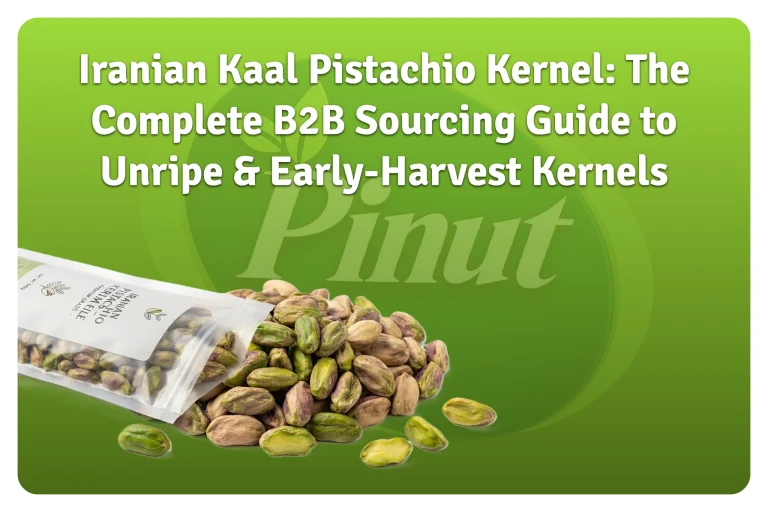
Iranian Kaal Pistachio Kernel: The Complete Sourcing Guide
Table of Contents
Short Answer: What is a Kaal pistachio kernel?
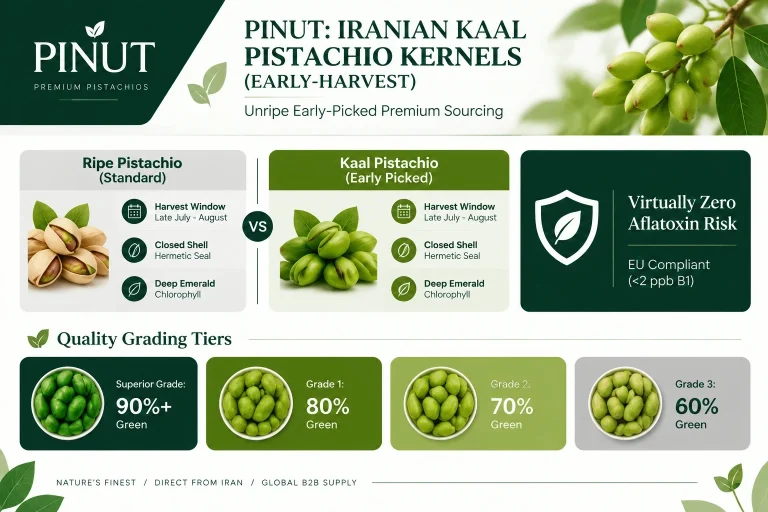
A Kaal pistachio kernel (also known as an unripe or early-picked pistachio kernel, and natively termed Boz) is harvested 30 to 45 days before physiological maturity (typically late July to early August) while the protective outer hull remains closed. Because it is harvested early, it features an intense emerald green interior, exceptional heat-stable chlorophyll, a higher protein-to-fat ratio, and virtually non-detectable aflatoxin levels. Graded from Superior (90%+ green) down to Grade 3 (60% green), Kaal kernels are the most premium, high-value raw ingredient for European, Japanese, and Middle Eastern industrial confectionery, artisanal gelato, and luxury pastry manufacturers.
Why Global Food Innovators Seek Early-Picked Kernels
In the competitive landscape of commercial food manufacturing, visual appeal and ingredient purity define market dominance. While standard mature pistachios offer high oil content and savory richness, they lack the vivid, thermal-resistant emerald coloration demanded by luxury confectioners, artisanal chocolatiers, and modern clean-label food brands.
This functional demand is met by the Iranian Kaal pistachio kernel.
Harvested weeks ahead of the regular season across the historic orchards of Kerman and Rafsanjan, these early-picked treasures represent the pinnacle of Iranian agricultural craftsmanship. However, sourcing unripe kernels in bulk presents distinct commercial challenges: variable sorting grades, complex post-harvest peeling, supply-demand volatility, and strict international compliance.
Whether you are a procurement manager sourcing wholesale lots or a food scientist developing clean-label formulations, this definitive guide provides the technical, logistical, and commercial intelligence required to source authentic Kaal pistachio kernels with total confidence.
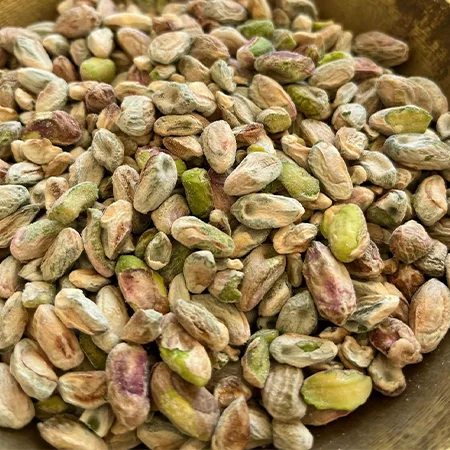
1. What Exactly is a Kaal (Unripe) Pistachio Kernel?
The term Kaal (کال) translates directly to “unripe” or “raw” in Persian. In local agricultural trade, farmers and processors also refer to this stage as the Boz pistachio.
Unlike conventional harvesting—which occurs between late September and mid-October when the hull softens and the inner shell splits open naturally—Kaal harvesting takes place prematurely between late July and mid-August. At this stage, the embryonic kernel has fully developed inside the shell, but the natural ripening cycle that converts pure chlorophyll into lighter yellowish fats and oils has not yet occurred.
Key Physiological Characteristics:
- Deep Emerald Pigmentation: The kernel retains maximum concentrations of natural chlorophyll and , ensuring an authentic green hue without synthetic colorants.
- Firm, Crisp Texture: Because early kernels contain less mature lipid oils and more structured plant moisture, they retain superior textural integrity during baking, chopping, and slivering.
- Compact Caliber: Kaal kernels are physically denser and smaller than ripe counterparts, yielding more units per kilogram, which improves distribution across industrial batters and confectionery bars.
2. Ripe vs. Kaal (Unripe) Pistachio Kernels: The Industrial Comparison
To make sound procurement decisions, B2B buyers must understand the trade-offs between standard iranian pistachio kernel selections and early-harvest Kaal grades.
| Parameter | Standard Ripe Kernel (Regular) |
Premium Grade Kaal (Early-Picked) Pistachio Kernel |
|---|---|---|
| Harvest Window | Late September – October | Late July – Mid August |
| Shell Condition | Naturally Split (Open) | Closed & Sealed (Unsplit) |
| Internal Color | Yellowish-Green to Pale Green | Deep Emerald to Forest Green |
| Fat / Oil Content | High (~53% – 56%) | Moderate (~46% – 49%) |
| Protein Content | Standard (~20%) | Significantly Higher (~22% – 24%) |
| Aflatoxin Risk Profile | Moderate (Requires rigorous sorting) | Near-Zero / Clean EU Compliance |
| Thermal Color Stability | Fades to tan/brown under oven heat | Retains vivid green under high heat |
| Price Benchmark | Baseline Market Commodity | Premium Tier (30% to 60% surcharge) |
For food processors formulating pure nut pastes, comparing early-harvest kernels against standard processing grades is critical; for instance, high-end pistachio paste intended for luxury gelato demands the vivid natural chlorophyll that only Kaal kernels can guarantee.
3. The Unbeatable Safety Advantage: Why Kaal is Virtually Aflatoxin-Free
For importers targeting the European Union, the United Kingdom, and Japan, mycotoxin contamination—specifically Aflatoxin B1 and total aflatoxins—is the single greatest regulatory barrier.
Aflatoxins are toxic secondary metabolites produced by fungi such as Aspergillus flavus and Aspergillus parasiticus. These molds thrive when two conditions meet:
- Warm, humid environmental spores.
- Direct access to the nutrient-rich kernel flesh.
In fully mature crops, the protective shell naturally splits open on the tree (creating an open split pistachio). If hull integrity breaks down early, fungal spores land directly on the kernel.
The Kaal Biological Defense:
Because Kaal pistachios are harvested early:
- Hermetic Hull Seal: The hard endocarp remains tightly closed and hermetically sealed within a firm, intact outer hull.
- Zero Spore Penetration: Fungal spores have zero mechanical pathway to reach the kernel.
- Dry Summer Harvest: Harvesting in late July bypasses the seasonal late-summer rains and humidity drops that spur Aspergillus colonization.
As a result, unadulterated Kaal pistachio shipments routinely test well below strict EU thresholds (Total Aflatoxin < 4 ppb, B1 < 2 ppb), making them the safest possible import format for highly regulated markets.
4. International Grading Matrix for Kaal Pistachio Kernels
In export commerce, raw Kaal kernels (sold with their thin, inner reddish/purple skin intact) are categorized strictly by their internal green density after cracking. The industry utilizes a four-tier standard:
Kaal Color Grading Standards
Optical Sorter & Density Thresholds
- Superior Grade (Grade S / 90%+ Green):The pinnacle of export quality. Over 90% of the entire batch displays uniform, deep green pigmentation. Reserved for high-end retail packaging, Michelin-star culinary applications, and the primary base for Grade A Green Peeled Pistachio Kernels (GPPK).
- Grade 1 (80% Green):An exceptional commercial standard. Minimum 80% green kernels, with minor presence of lighter tones. The preferred choice for premium industrial bakeries, Turkish baklava manufacturers, and chocolate enrobing.
- Grade 2 (70% Green):Balanced cost-to-performance ratio. Frequently integrated into chopped nut mixes, nougat bars, and medium-scale confectionery formulations.
- Grade 3 (60% Green):Budget-conscious raw material utilized extensively where kernels will be micro-milled, incorporated into fillings, or blended with other nut pastes.
5. Major Cultivars Used for Early-Picked Kernels
Not every pistachio tree produces identical Kaal results. Iranian growers select specific cultivars based on regional microclimates and the desired end-use:
- Kalleh-Ghoochi (Jumbo Cultivar): Produces a wide, sphere-like Kaal kernel that is particularly popular in industrial slicing because of its broad diameter. Learn more about the tree and crop characteristics in our guide to Jumbo Pistachio Kallehghouchi.
- Akbari & Ahmad Aghaei (Long Cultivars): Highly prized for producing long, elegant slivers (Khalal) used extensively in traditional Mediterranean pastry and Persian rice garnishes. Discover structural differences in our detailed comparison of Akbari vs Ahmad Aghaei.
- Fandoghi (Round Cultivar): The workhorse of high-volume processing. Offers high yields per orchard and consistent green consistency at a competitive bulk price point. Explore our review of the Iranian round pistachio.
To evaluate the broader biological and commercial differences across the entire harvest spectrum, explore our foundational breakdown of all pistachio types.
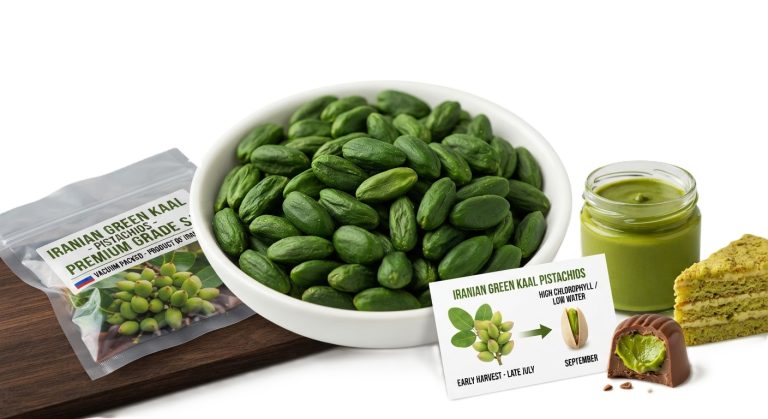
6. Industrial Applications: Where Kaal Kernels Excel
Global processors choose Kaal kernels over other nut varieties because of their unique structural and sensory properties:
A. High-Heat Confectionery & Pastry (Baklava & Macarons)
Conventional nuts lose their visual identity when baked above 160°C (320°F), oxidizing into an unattractive dull yellow or brown. Kaal kernels, possessing natural, thermally resilient chlorophyll, preserve their vibrant green coloration throughout aggressive baking cycles, delivering a clean-label, color-additive-free finished product.
B. Artisanal Gelato & Fine Ice Creams
True Italian and European gelato formulations avoid artificial food dyes (such as E141 or Tartrazine). Processing Superior Grade Kaal into an unctuous paste produces a striking, authentic pistacchio green with delicate floral notes, avoiding the heavy, oily aftertaste of mature seeds.
C. Bean-to-Bar Chocolates & Pralines
Because Kaal kernels have lower surface lipid accumulation, they do not cause fat-bloom issues when enrobed into milk or dark chocolate matrices. Their crisp bite creates an elevated contrast against smooth cocoa butter.
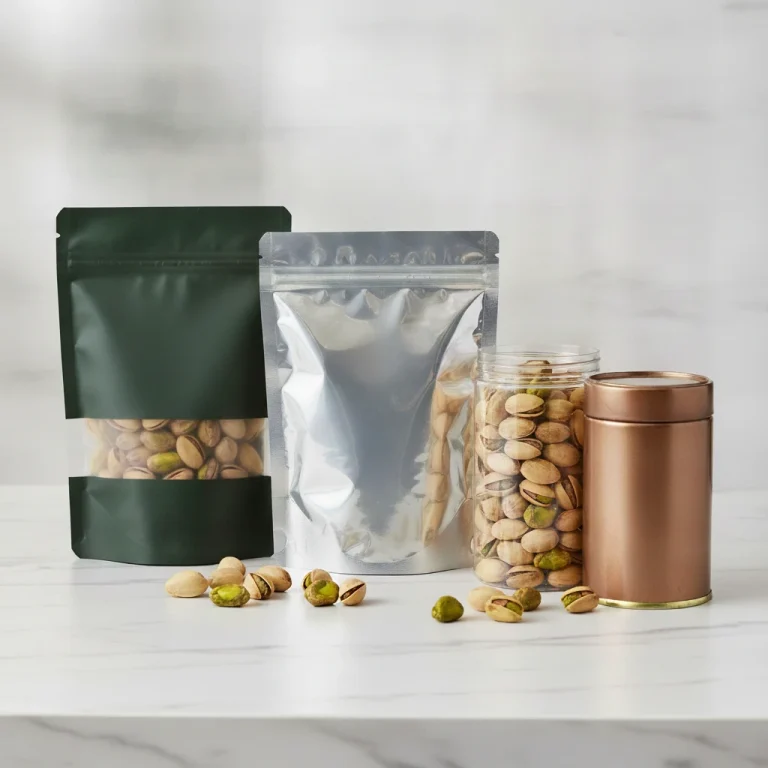
7. Packaging, Nitrogen Flushing & Logistics for Bulk Export
Preserving the delicate chlorophyll in early-picked kernels requires strict supply chain parameters. Chlorophyll is photo-sensitive and degrades rapidly when exposed to oxygen and ultraviolet radiation.
At Pinut, our export packaging protocol guarantees freshness from our Kerman facilities to global receiving ports:
- Primary Barrier: Heavy-duty, multilayer aluminum vacuum bags injected with Food-Grade Nitrogen () to eliminate oxygen down to .
- Carton Packaging: Packed into robust, corrugated 10 kg, 12.5 kg, or 25 kg export-grade cartons.
- Transit Temperature: Transported in temperature-controlled reefer containers maintained between and with relative humidity under 60%.
- Private Label Solutions: For buyers seeking ready-for-shelf or tailored wholesale configurations, explore our bespoke pinut private labeling capabilities.
8. Sourcing Checklist: How to Place an RFQ for Kaal Pistachio Kernels
When submitting a Request for Quotation (RFQ) to an international Iranian pistachios exporter, include the following parameters to ensure accurate pricing and lead-time estimation:
- Target Specification: State whether you require raw unpeeled Kaal (with skin) or Double-Peeled (GPPK).
- Color Grade Target: Specify required green threshold (Superior 90%, Grade 1 80%, etc.).
- Microbiological & Chemical Tolerances: Confirm your destination country’s maximum allowable ppb for Aflatoxin B1/Total and moisture content (typically strictly ).
- Packaging Format: Select between 10kg/12.5kg vacuum cartons or bulk modified-atmosphere bags.
- Incoterms & Port of Entry: Indicate CIF, FOB Bandar Abbas, or CFR destination port to calculate prompt freight dynamics.
To evaluate our verified supply chain capabilities, visit the official About Pinut company profile or browse our full export catalog across all products.
Conclusion: Partner with Pinut for Guaranteed Kaal Sourcing
The Iranian Kaal pistachio kernel is not merely another raw nut ingredient—it is an elite functional asset that enhances product appearance, satisfies clean-label consumer preferences, and provides unprecedented protection against food-safety rejections at border control.
Sourcing these limited-harvest crops demands a partner with deep local roots in Rafsanjan, automated sorting technology, and strict laboratory testing protocols. At Pinut, we oversee the supply chain from early summer orchard management through vacuum packaging and freight execution, ensuring your production lines receive uncompromised quality year-round.
Ready to secure forward-contract pricing or request laboratory specification sheets and samples for your next manufacturing cycle? Contact Us today to speak directly with an agricultural trade specialist.
