
Blog
Factors Affecting Iranian Pistachio Prices in 2026: A Strategic Sourcing Guide for Global Importers
Table of Contents
Executive Summary / 2026 Market Outlook
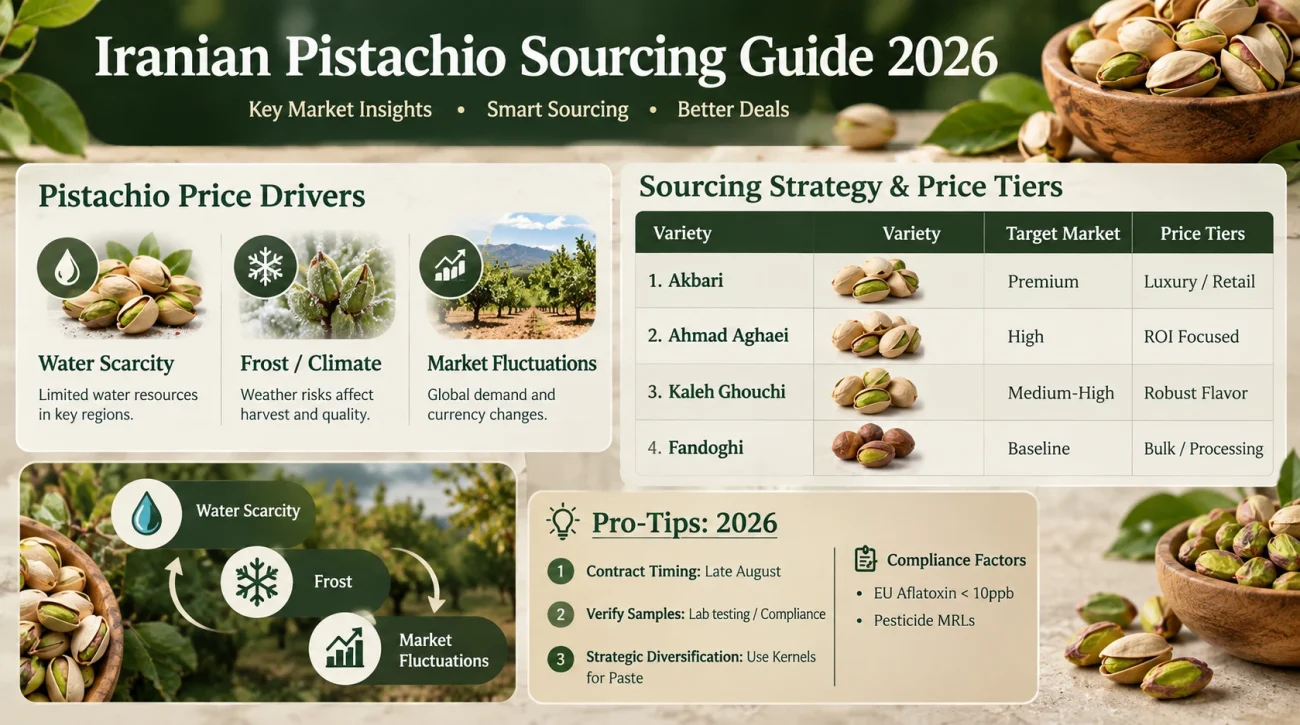
The 2026 Iranian pistachio market presents a complex but highly opportunistic landscape for global bulk importers and commodity traders. Entering the new crop cycle, FOB and CIF prices are expected to experience moderate volatility driven by a convergence of environmental constraints in primary growing regions and shifting geopolitical trade routes. While total yield forecasts suggest a stable volume, the premium placed on high-caliber, perfectly graded nuts will widen the price gap between standard commercial grades and luxury export qualities. For procurement managers across Europe, Asia, and the Middle East, locking in competitive Iran pistachio prices requires early market entry, a deep understanding of cultivar valuations, and strategic alignment with established exporters capable of navigating international compliance standards.
Key Price Drivers in 2026
Climatic & Environmental Factors
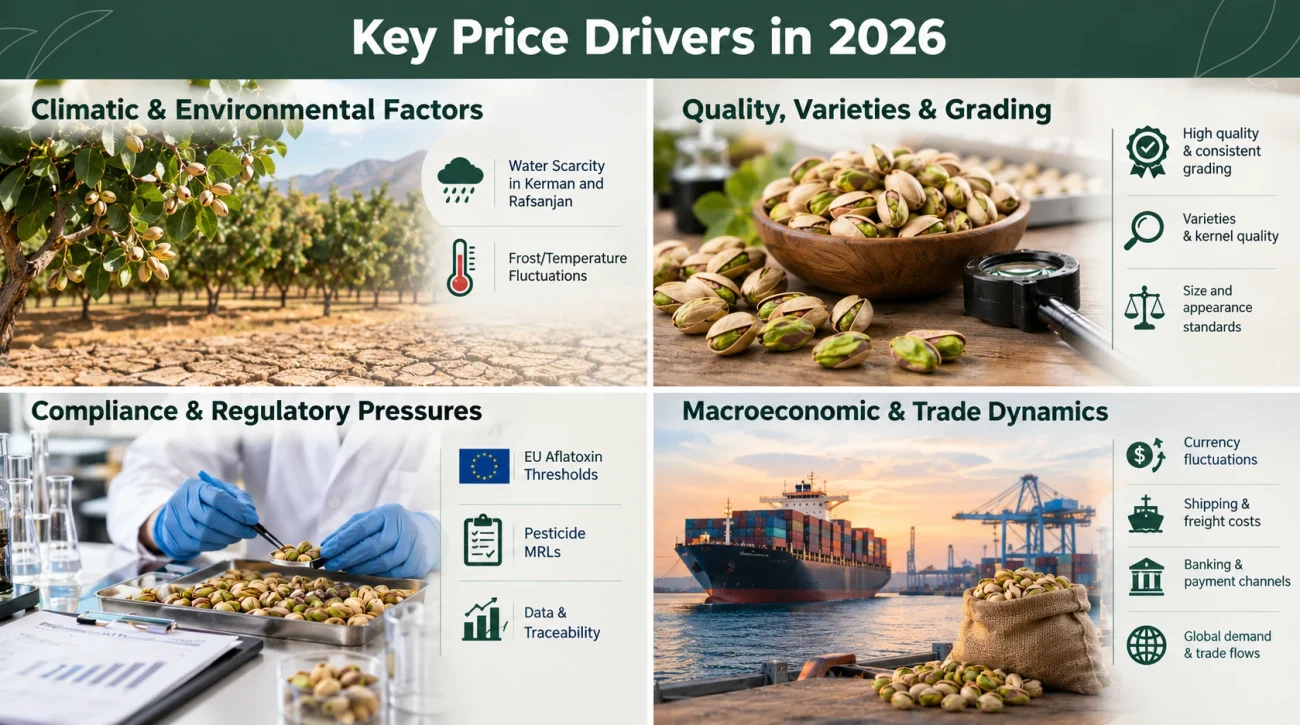
Agricultural realities remain the baseline determinant for wholesale pistachio pricing. In 2026, the traditional growing hubs are facing distinct environmental pressures:
Water Scarcity in Kerman and Rafsanjan: Depleting water tables continue to increase cultivation overhead for farmers. Orchards relying on deeper well irrigation pass these operational costs onto the final bulk price.
Frost and Temperature Fluctuations: Late spring frosts during the critical pollination window can drastically reduce the yield of open-shell pistachios, driving up the cost of premium grades.
Alternate Bearing Cycle: Understanding the “on-year” versus “off-year” biological cycle of pistachio trees is vital. Importers must adjust their volume expectations and budget for potential supply constrictions if key regions experience an off-year harvest.
Quality, Varieties & Grading
Price disparity in the Iranian market is heavily dictated by the specific cultivar, ounce count (nuts per ounce), and the ratio of naturally open to mechanically opened shells. Diverse global markets have distinct preferences, directly impacting demand-side pricing.
Persian Pistachio Commercial Varieties
A comparative overview of kernel profiles, target international markets, and global commercial valuation tiers.
| Variety & Shape | Key Physical Characteristics | Primary Target Markets | Market Price Tier |
|---|---|---|---|
|
Akbari
Super Long
|
Highest kernel-to-shell ratio, elongated and visually luxurious profile, exceptionally easy to crack. | Middle East (UAE, Qatar), India, Luxury Gift Retail | Premium / Benchmark |
|
Ahmad Aghaei
Long
|
Brightest white shell, rich natural red hull tint, vibrant green kernel with outstanding roasting flavor. | European Union, India, East Asia | High Value |
|
Kaleh Ghouchi
Jumbo
|
Spherical hazelnut-like shape, thick shell, generous heavy kernel with intense nutty profile. | Europe (Germany, Italy), Regional Wholesalers | Medium-High |
|
Fandoghi
Round
|
Smallest spherical silhouette, maximum piece count per kilogram, high yield and cost-effective. | China, CIS Countries, Food Service & Confectionery | Baseline / High-Volume |
Market Insight: Buyers evaluating Akbari versus Ahmad Aghaei varieties should note that while Akbari commands the highest FOB price, Ahmad Aghaei often provides a superior ROI for mid-tier European and Indian retail markets due to its exceptional visual appeal and slightly lower bulk cost. Importers seeking high-volume commercial processing should focus on Fandoghi and Kaleh Ghouchi differences to optimize raw material budgets.
Compliance & Regulatory Pressures
For buyers in stringently regulated markets, compliance is a non-negotiable cost driver. The expenses associated with processing, sorting, and certifying pistachios to meet international standards are baked into the final export price.
EU Aflatoxin Thresholds: Exporting to the European Union requires rigorous, state-of-the-art optical and laser sorting to guarantee aflatoxin levels remain below 10 ppb (total) and 8 ppb (B1). Lots that pass these strict laboratory tests carry a premium price tag.
Pesticide MRLs: Maximum Residue Limits (MRLs) dictate chemical usage. As global markets tighten these regulations, organic or strictly controlled IPM (Integrated Pest Management) yields command higher valuations.
Lab Testing & Phytosanitary Costs: Independent SGS or equivalent third-party lab testing ensures compliance but adds incremental costs to bulk shipments.
Macroeconomic & Trade Dynamics
Financial and geopolitical realities uniquely shape the pistachio export wholesale market in Iran, often overriding pure supply-and-demand economics.
Forex Fluctuations: The delta between the Iranian Rial (IRR) and major global currencies (USD/EUR) can create sudden windows of buying opportunity or unexpected price inflation for forward contracts.
Shipping Routes and Logistics: The efficiency of mapping and executing maritime and overland freight routes is critical. High-volume export corridors directly to Jebel Ali (UAE), Nhava Sheva (India), and key ports in China and Europe are highly developed, yet volatile freight rates can impact the final CIF price.
Banking and Payment Channels: Importers must work with established Iranian pistachio exporters who have reliable, compliant financial infrastructures in place through third-country banking hubs (e.g., in the UAE or Oman) to facilitate smooth transactions.
Global Market Competition
To execute a successful procurement strategy, buyers must weigh Iranian prices against global alternatives.
The California Alternative: While US yields are massive, Iranian pistachios consistently retain a price premium in flavor-focused markets due to their higher oil content, which withstands roasting at higher temperatures. Importers actively assessing comparative pricing dynamics against California pistachios often split their procurement: using US nuts for low-cost generic retail, and Iranian nuts for premium product lines and culinary applications.
Turkey and Syria: These origins primarily serve domestic or regional demand, leaving Iran as the dominant supplier of premium long and jumbo cultivars for the broader international market.
Procurement Strategy / Buying Advice
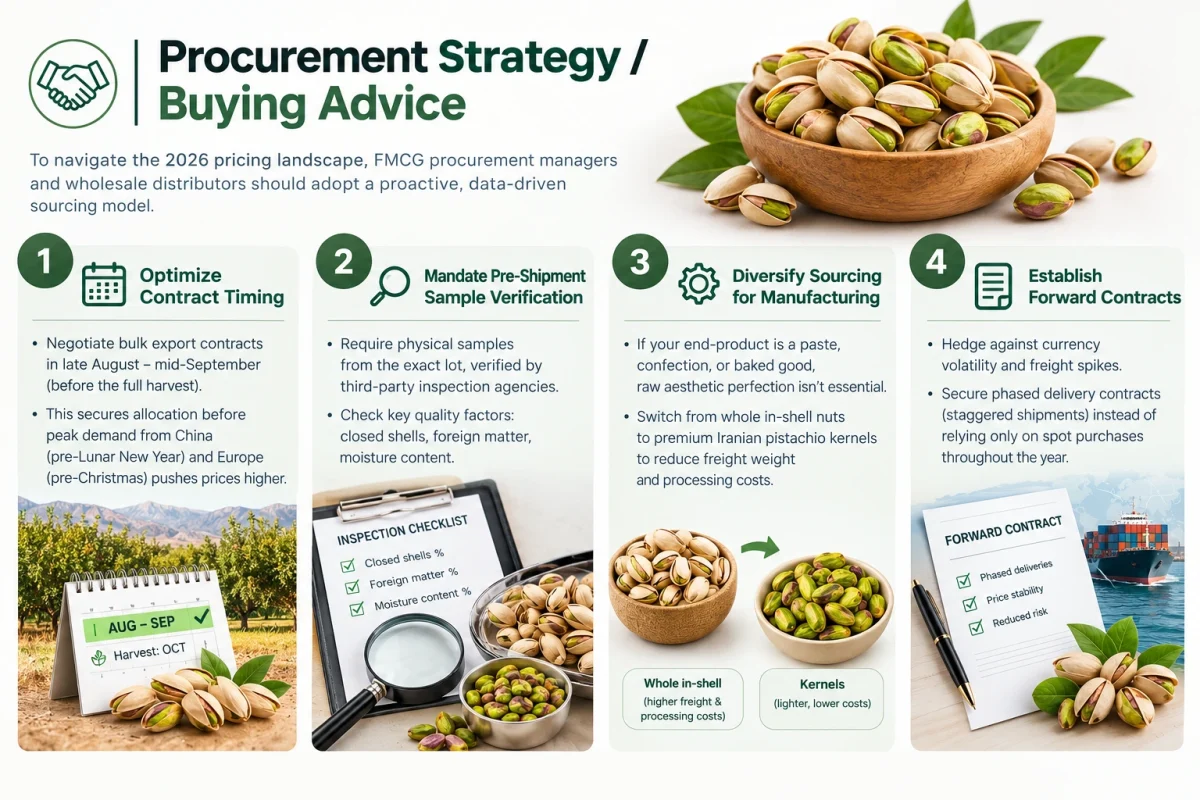
To navigate the 2026 pricing landscape, FMCG procurement managers and wholesale distributors should adopt a proactive, data-driven sourcing model.
Optimize Contract Timing: The Iranian harvest window occurs between late September and October. The optimal time to negotiate pistachio bulk export contracts is during late August to mid-September, just before the full harvest is finalized. This secures allocation before peak demand from China (pre-Lunar New Year) and Europe (pre-Christmas) spikes the market rate.
Mandate Pre-Shipment Sample Verification: Always require physical samples representing the exact lot, verified by third-party inspection agencies. Pay close attention to the percentage of closed shells, foreign matter, and moisture content.
Diversify Sourcing for Manufacturing: If your end-product is a paste, confection, or baked good, raw aesthetic perfection is unnecessary. Transitioning procurement from whole in-shell nuts to premium Iranian pistachio kernels can drastically reduce freight weight and processing costs.
Establish Forward Contracts: To hedge against currency volatility and freight spikes, secure phased delivery contracts (staggered shipments) rather than relying exclusively on spot market purchases throughout the year.
Conclusion & Strategic Next Steps
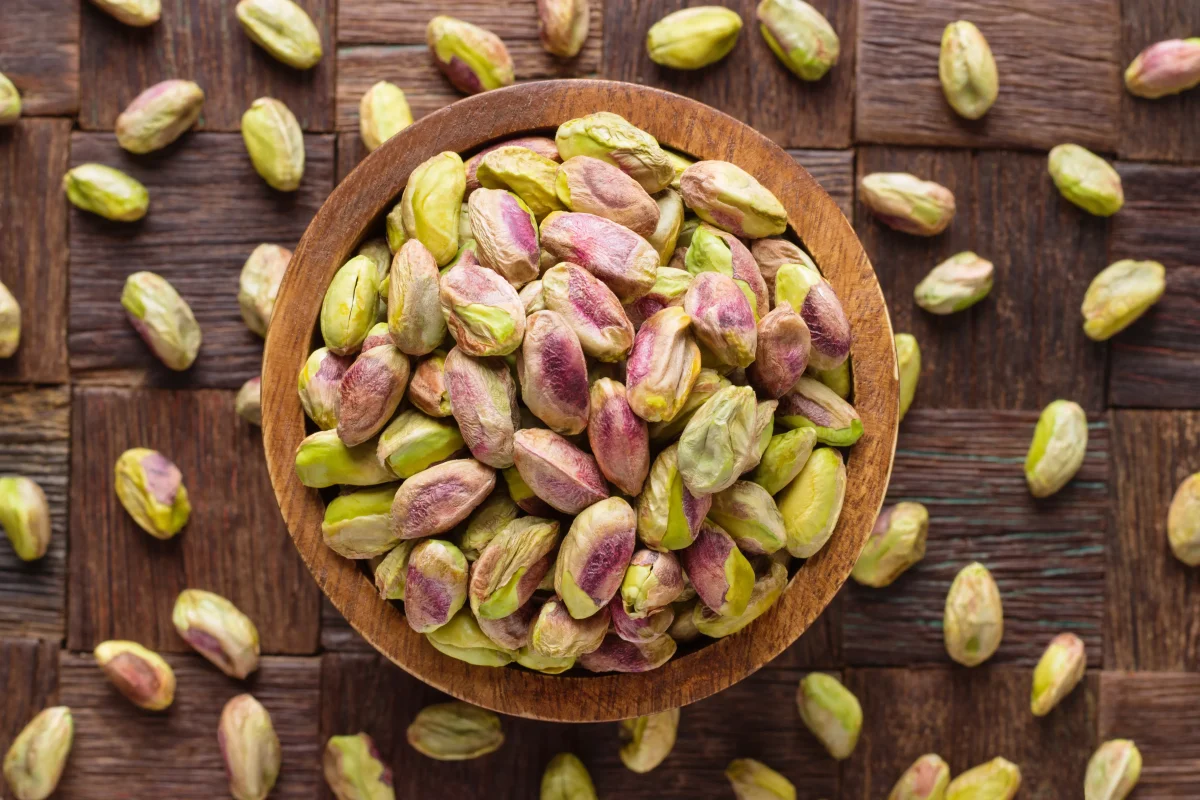
Securing a stable, cost-effective supply of Iranian pistachios in 2026 requires more than simply checking spot prices; it demands a strategic partnership with an exporter capable of mitigating agricultural, regulatory, and logistical risks. Whether your market demands luxury in-shell Akbari for UAE boutiques or bulk Fandoghi kernels for European confectionery, aligning your procurement timing with harvest cycles and compliance requirements is the key to protecting your margins.
Ready to secure your 2026 supply chain? Contact our export team for custom CIF/FOB quotes, comprehensive specification sheets, and tailored B2B wholesale pricing.
Frequently Asked Questions (B2B Sourcing & Export)
- 080251: Pistachios, fresh or dried, in shell.
- 080252: Pistachios, fresh or dried, shelled (kernels).
