Blog
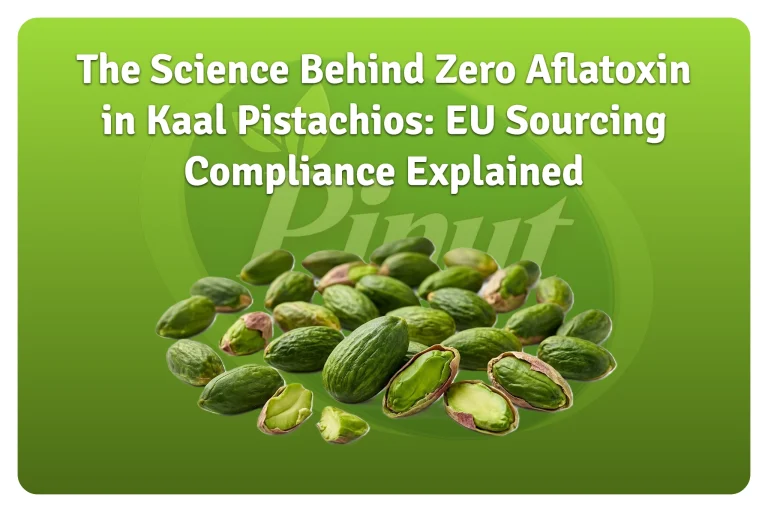
The Science Behind Zero Aflatoxin in Kaal Pistachios: EU Sourcing Compliance Explained
Table of Contents
Key Takeaways (Short Answer)
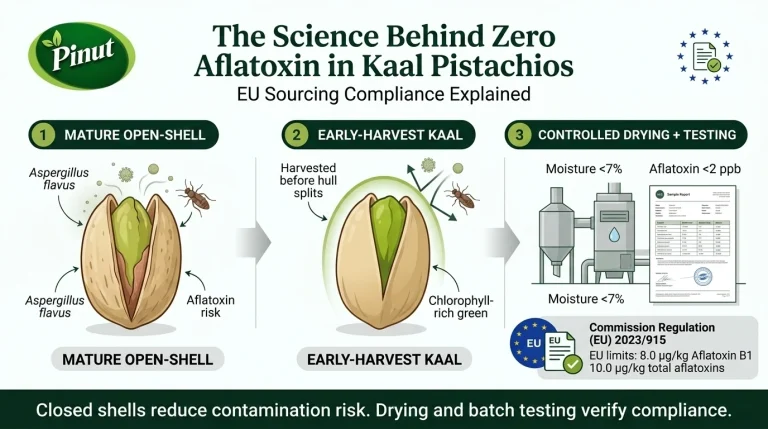
Early-harvest Iranian Kaal pistachio kernels achieve near-zero or negligible aflatoxin levels because they are harvested before the hull splits on the tree—bypassing the critical vulnerability window where Aspergillus flavus spores infect mature nuts via air or insect vectors. For EU importers and commercial food manufacturers navigating Commission Regulation (EU) 2023/915 (which sets strict maximum limits for aflatoxin B1 and total aflatoxins), sourcing early-harvest Kaal pistachio kernels provides a bulletproof compliance strategy, exceptional chlorophyll density, and absolute peace of mind for B2B supply chains.
Introduction
For global B2B buyers, importers, and luxury confectionery manufacturers, food safety and regulatory compliance are non-negotiable. Among all quality parameters, aflatoxin contamination—produced by toxigenic fungi such as Aspergillus flavus and Aspergillus parasiticus—remains the single biggest hurdle when importing tree nuts into the European Union.
While mature open-mouth pistachios require rigorous optical sorting, laser screening, and multi-stage laboratory testing to clear strict EU borders, a superior alternative has captured the attention of top-tier industrial procurement managers: Kaal (early-harvest) pistachio kernels. By understanding the biological, physical, and agricultural mechanisms of early-harvest processing, buyers can leverage Iranian pistachios to eliminate regulatory risks while securing unmatched vibrant green color and rich oil profiles.
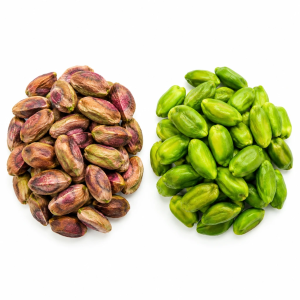
1. The Biology of Contamination: Why Mature Open-Shell Pistachios Face Aflatoxin Risks
To understand why Kaal pistachios perform exceptionally well in laboratory tests, we must examine how Aspergillus flavus infects pistachio orchards:
- The Natural Split Vulnerability: During late summer ripening, the outer hull and hard shell of a standard pistachio split naturally on the branch (dehan baaz). This split exposes the nutrient-dense kernel to ambient air, humidity, and insect vectors (such as navel orangeworm).
- Fungal Colonization: If ambient temperatures range between and and relative humidity fluctuates, Aspergillus spores germinate within these splits, metabolizing carbohydrates and synthesizing toxic secondary metabolites (aflatoxin B1, B2, G1, G2).
- The Post-Harvest Factor: Delayed harvesting or slow sun-drying can exponentially increase contamination rates in mature open-shell crops.
(For a broader overview of how different grades compare in commercial applications, review our guide on Kaal Pistachio Kernels vs. GPPK.)
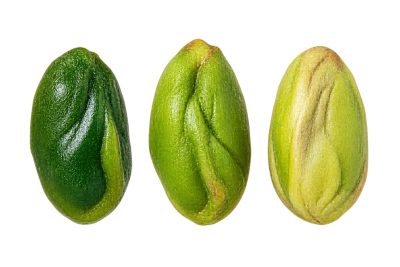
2. The Kaal Advantage: Mechanical Protection & Early Harvest Mechanics
Kaal pistachios are harvested weeks before full physiological maturity, typically in late summer when the fruit is still firmly enclosed within a tightly sealed, intact hull and shell structure.
- Physical Barrier Integrity: Because the shell remains completely closed and un-split (unsplit/closed shell), airborne fungal hyphae and insect-borne spores cannot penetrate the protective endocarp barrier.
- Moisture and Metabolic State: Early-harvest kernels possess higher cellular moisture and peak chlorophyll density before natural senescence begins. When subjected to rapid, controlled industrial drying (reducing moisture levels below the critical threshold of and water activity ), fungal proliferation is entirely inhibited.
- Laboratory Results: Randomized batch testing consistently shows that high-grade Kaal pistachio kernels record aflatoxin levels well below the stringent limits imposed by European regulatory bodies.
3. EU Sourcing Compliance: Decoding Commission Regulation (EU) 2023/915
The European Union maintains some of the most rigorous food safety laws globally under Commission Regulation (EU) 2023/915 (setting maximum levels for certain contaminants in food stuffs).
- The Thresholds: For pistachios intended for direct human consumption or use as a food ingredient, EU limits are strictly capped (e.g., for Aflatoxin B1 and for total aflatoxins, with slightly higher allowances for lots requiring secondary physical sorting).
- Risk Mitigation for Importers: Traditional shipments often face costly border rejections or mandatory re-exportation if a single composite sample exceeds these parts-per-billion (ppb) limits. By partnering with a trusted pistachio supplier and exporter that controls orchard-to-export quality control, buyers of Kaal kernels effectively bypass the high-risk statistical variance associated with mature open-mouth crops.
Conclusion
In the competitive landscape of global food manufacturing, gourmet gelato production, and high-end confectionery, mitigating supply chain risk is paramount. Early-harvest Iranian Kaal pistachio kernels offer a dual advantage: they deliver extraordinary chlorophyll-rich green color and deep flavor profiles while physically preventing Aspergillus flavus colonization through an un-split shell structure. By integrating Kaal sourcing into your procurement strategy, your brand secures absolute compliance with EU food safety standards and guarantees peace of mind for every commercial batch.
