Blog
Aflatoxin Control & Quality Standards for Exporting Iranian Pistachio Kernels
Short Answer
Iranian pistachio kernels meet international export safety standards—including strict European Union limits of ≤8 ppb for Aflatoxin B1 and ≤10 ppb for Total Aflatoxin in ready-to-eat products—through a multi-stage Quality Assurance (QA) system. This protocol integrates early automated harvest, rapid hot-air drying below 6% moisture, UV/Optical laser sorting, and certified HPLC laboratory testing. Importers can verify quality by checking official Certificates of Analysis (COA) for aflatoxin, moisture levels, purity, and grading standards.
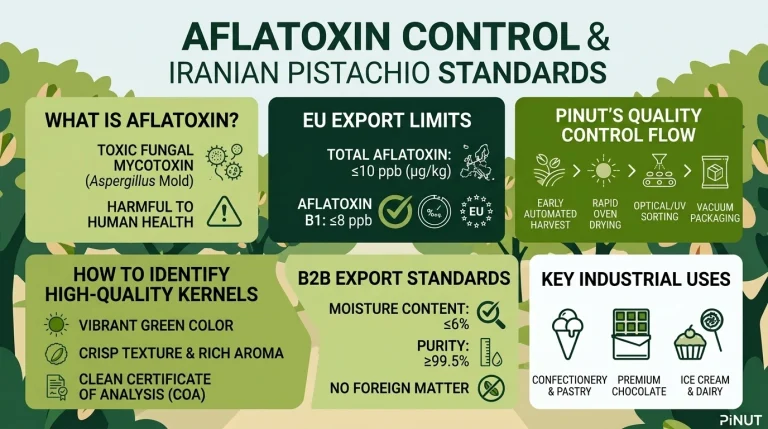
Aflatoxin Control & Quality Standards for Exporting Iranian Pistachio Kernels-infographic
Aflatoxins are toxic mycotoxins produced by specific mold strains, primarily Aspergillus flavus and Aspergillus parasiticus, which can colonize tree nuts under warm, humid conditions. In global supply chains, controlling aflatoxins is the single most critical compliance benchmark for food processing companies, confectioners, and wholesale importers.
For premium iranian pistachio kernel products, maintaining zero-tolerance or regulatory-compliant mycotoxin levels is required to enter high-value markets across Europe, Asia, and North America.
Aflatoxin Regulatory Standards
Maximum allowable limits by market region and standards authority
| Market Region | Max Aflatoxin B1 Limit | Max Total Aflatoxin Limit | Regulatory Framework / Standard |
|---|---|---|---|
| European Union (Direct Consumption) | 8.0 ppb (μg/kg) | 10.0 ppb (μg/kg) | Regulation (EU) 2023/915 |
| European Union (Industrial Processing) | 12.0 ppb (μg/kg) | 15.0 ppb (μg/kg) | CODEX / EU Regulations |
| Codex Alimentarius / Global Standard | — | 15.0 ppb (μg/kg) | CAC/GL Standards |
| Iranian National Standard (ISIRI) | 5.0 ppb (μg/kg) | 15.0 ppb (μg/kg) | ISIRI 5925 |
Step-by-Step Aflatoxin Control Protocol in Iranian Processing Facilities
Top-tier processors implement a farm-to-shipment framework designed to prevent mold development before, during, and after harvesting:
- Timely Harvesting & De-husking: Pistachios are harvested immediately upon ripening to avoid hull rupture (early split) on tree branches, which lowers the risk of spore exposure.
- De-hulling and Washing: Modern processing lines quickly strip the outer green hull using continuous water baths and automated dehullers.
- Rapid Dehydration: Nuts are dried in industrial hot-air ovens within hours to bring internal moisture below 5.5%–6.0%, suppressing bacterial and fungal proliferation.
- Mechanical Shelling & Hulling: To supply iranian pistachios shelled, advanced cracking machinery carefully removes the hard shell without damaging the delicate inner kernel kernel tissue.
- Advanced Optical & UV Sorting: Processing facilities utilize high-resolution optical and UV/laser sorters. Kernels displaying fluorescence (often associated with high aflatoxin concentrations) or surface blemishes are separated.
- Vacuum Packaging: Bulk kernels are packed in multi-layer aluminum vacuum bags with nitrogen flushing to eliminate oxidation and moisture re-absorption during sea transport.
How to Identify High-Quality Iranian Pistachio Kernels
Buyers and quality control teams can evaluate kernel lots using sensory, physical, and laboratory methods:
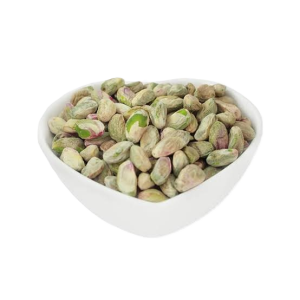
- Visual Inspection & Color Uniformity: Premium varieties like iranian green pistachio kernel are graded by color intensity (ranging from deep S/A grade green to lighter shades). High-grade kernels feature intact seed coats without dark discoloration, black spots, or mold traces.
- Aroma & Flavor Profile: Crisp texture with a rich, nutty profile indicates proper drying and low moisture. Any rancid, sour, or musty smell signals fat oxidation or poor storage conditions. You can read more about fresh product storage in our guide on how to tell if pistachios have gone bad.
- Purity & Size Grading: Quality shipments contain minimal foreign matter, split shells, or dust. Whether sourcing whole kernels, splits, or fine iranian pistachio powder for confectionery, particle uniformity is essential.
- Chemical Certificate Analysis (COA): Always demand an accredited High-Performance Liquid Chromatography (HPLC) test report verifying moisture levels (<5%), peroxide values (<1 meq/kg), and exact aflatoxin readings.
Key Iranian Pistachio Varieties and Export Grades
Different cultivars yield distinct kernel shapes, colors, and fat contents suitable for culinary, industrial, and snacking uses:
- Akbari
- Ahmad Aghaei
- Fandoghi
- Kalleh Ghouchi
- Kaal (Early Harvest)
- Green Peeled (GPE)
- Long Varieties (Akbari & Ahmad Aghaei): Favored for their elongated shape and elegant appearance. Learn more in our comparison between Akbari vs Ahmad Aghaei and explore Iranian Long Super Long Pistachios.
- Round Varieties (Fandoghi & Jumbo): High-yield kernels widely used in bulk production, snacks, and pastes. Check our detailed guide on Round vs Jumbo Pistachios or discover Jumbo Pistachio Kallehghouchi.
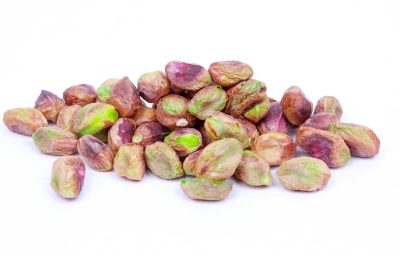
- Green Peeled Kernels (GPE): Obtained by peeling the skin off early-harvested nuts to reveal an intense green hue, making them ideal for chocolates, ice cream, and pastry coatings.
- Processed By-products: Premium kernels are processed into specialized industrial ingredients such as pistachio paste and fine ground powders.

Health, Culinary, and B2B Value of Iranian Pistachios
Beyond safety compliance, what is pistachio kernel? It is the nutrient-dense seed found inside the hard outer shell, packed with healthy fats, dietary fiber, antioxidants, and plant-based protein.
Whether offering raw nuts or processing raw vs roasted pistachios, iranian green pistachio offerings remain a global benchmark for culinary flavor. Furthermore, consumers enjoy numerous health advantages, including pistachio health benefits, support for pistachios weight loss benefits, assistance with pistachios and diabetes management, and the restful benefits of eating pistachios before bed.
For detailed nutrient analyses, read our comparison on pistachios vs almonds health benefits compared or learn how many pistachios a day fit into a healthy diet.
Conclusion
Securing export-ready iranian pistachio kernel supplies requires strict alignment between orchard management, modern processing technology, and certified laboratory validation. By adhering to EU mycotoxin limits, employing automated optical sorting, and utilizing vacuum packaging, certified producers guarantee safe, premium ingredients for worldwide distribution.
If you are looking for certified export supplies or custom packing, explore Pinut Private Labeling, learn more About Pinut, check our full range of Pinut Services, or Contact Us directly for wholesale quotes.
